Why Food Tastes Different at 35,000 Feet — And What the Best Airlines Are Doing About It
The neuroscience of airline food, and why a Michelin-starred kitchen can't fully save your dinner at altitude
You order the salmon. At home, you never order the salmon. But somewhere over the North Atlantic, at 37,000 feet in a pressurized metal tube with recycled air and a drone of engines, the lamb option suddenly looks less appealing and the tomato juice — something you'd never touch on the ground — seems like an inspired choice. This is not a coincidence, and it's not just the wine talking.
The science of how altitude, pressure, and cabin conditions alter human taste perception has been studied seriously since the late 2000s. What researchers found is that flying changes your ability to taste in multiple, compounding ways — and that some airlines are investing heavily in fighting back.
30%
Reduction in salt perception
30%
Reduction in sweet perception
20%
Drop in overall taste intensity
8%
Cabin humidity vs. 50% at sea level
The Science: What Happens to Your Senses at Altitude
The Fraunhofer Institute for Building Physics in Germany conducted one of the most widely cited studies on in-flight taste perception in 2010. In a simulated aircraft cabin environment — replicating the low humidity (8%), reduced cabin pressure (equivalent to 6,000–8,000 feet altitude), and background engine noise — researchers found that subjects' sensitivity to sweet and salty flavors dropped by around 30% compared to sea level conditions.
Key Research Finding
The Fraunhofer Institute study found that in simulated cabin conditions, perception of sweet and salty tastes dropped by approximately 30% — not because the food changes, but because your taste buds' ability to register those flavors is suppressed by dry air and reduced pressure. Umami flavors, interestingly, remain largely unaffected.
Professor Charles Spence at Oxford University's Crossmodal Research Laboratory has studied the multi-sensory dimension of airline food extensively. His research identifies three distinct mechanisms at work:
Reduced olfactory function: Taste is largely smell. The nasal passages dry out in low-humidity cabin air (often as low as 8%, compared to a comfortable 40–60% at home), causing the mucous membranes that help carry scent molecules to your olfactory receptors to work less efficiently. Since roughly 80% of what we perceive as flavor comes from smell rather than the taste buds themselves, this single factor can dramatically flatten a dish.
Reduced pressure's effect on taste buds: At cabin pressure (the equivalent of 6,000–8,000 feet above sea level, maintained even when the plane is at 35,000 feet), taste receptor cells don't perform identically to how they do at sea level. Salty and sweet receptors are particularly affected.
Background noise: Spence's research found that loud background noise — specifically low-frequency noise like engine roar, typically around 85 decibels in economy class — suppresses the perception of sweet and salty tastes further while enhancing umami sensitivity. This is why tomato juice, high in glutamate and savory notes, tastes oddly good at 35,000 feet. And why Bloody Marys have become something of an aircraft institution.
The Umami Effect: Why Tomato Juice Rules the Sky
Tomato juice is the most ordered drink on Lufthansa flights — a statistic the airline regularly publishes. In 2013, Lufthansa reported selling around 53,000 liters of tomato juice on flights annually, a volume that far outpaces ground-level consumption habits of their passengers.
The explanation tracks perfectly with what Fraunhofer and Spence's research predicts. Tomato juice is rich in glutamates — the compounds responsible for umami flavor, which the cabin environment leaves largely intact. The savory, complex quality of tomato juice (and by extension, the appeal of Bloody Marys mid-flight) is less a personal quirk and more a biological response to the sensory environment you're sitting in.
The sound of the aircraft engine changes how food tastes. It suppresses sweet and salty while enhancing umami — which is why savory, complex flavors work so much better at altitude.
Prof. Charles Spence, Oxford Crossmodal Research Laboratory
Wine at Altitude: A Different Challenge
Wine is a particularly interesting case. Many frequent business class travelers report that wines they enjoy on the ground taste thin, harsh, or overly tannic mid-flight. The same mechanisms explain this: dried nasal passages suppress the aromatic compounds that give wine its complexity, and the salty/sweet suppression makes fruity, approachable notes retreat while tannins can feel more prominent.
Airlines that take their wine programs seriously have started to account for this directly. The solution isn't always to serve more expensive wine — it's to serve wines that retain character even when tasted through diminished sensory apparatus.
| Wine Type | At Ground Level | At 35,000 Feet | Altitude-Friendly? |
|---|---|---|---|
| Full-bodied red (Cabernet) | Rich, fruity, complex | Tannic, drying, harsh | ✗ Challenging |
| Sparkling (Champagne) | Fresh, acidic, yeasty | Retains acidity well; fine bubbles less perceptible | ✓ Good choice |
| Full-bodied white (Burgundy) | Buttery, complex oak | Holds up reasonably; oak less dominant | ✓ Good choice |
| Aromatic white (Riesling, Gewürz) | Floral, fruity, sweet | Sweetness muted; floral notes fade | ~ Mixed |
| Medium-bodied red (Pinot Noir) | Delicate, earthy, smooth | Still pleasant; lower tannin helps | ✓ Better than Cab |
Singapore Airlines is among the airlines that has formalized altitude wine testing, tasting wines in a pressurized cabin simulator before adding them to their cellar list. Their partnership with wine consultants specifically evaluates how labels perform under cabin conditions rather than simply at ground-level tastings.
The Michelin Arms Race in the Sky
How leading business class cabins are fighting the altitude effect with top culinary talent.
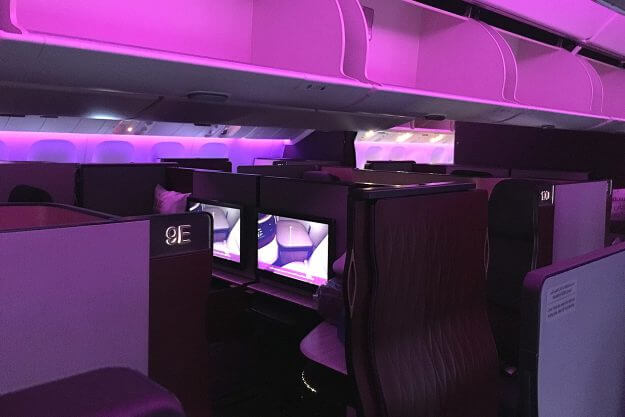
Qatar Airways · Qsuite
Yannick Alléno
★★★ Michelin (Pavillon Ledoyen, Paris)
Partnership launched June 2025. Alléno redesigned Qatar's business class menus with altitude-specific techniques: sauces built on natural glutamates, sous-vide proteins that maintain texture at low humidity, and a reduced reliance on salt in favor of acid-forward flavor profiles that remain perceptible at 35,000 feet.
Air France · La Première & Business
Daniel Boulud & Dominique Crenn
★★★ Michelin (multiple venues)
2025 collaboration. Air France's renewed culinary program pairs two of French-American cuisine's most celebrated chefs. Boulud's classical technique and Crenn's poetic, terroir-driven approach together inform menus tested specifically for how they hold up under cabin pressure and low humidity conditions.
Discover Airlines
Egor Hopp
★ Michelin (Frankfurt)
Partnership announced August 2026. Hopp's modern German cuisine brings an ingredient-first philosophy to Discover's business class — focusing on seasonal produce that naturally delivers strong umami and aromatic compounds that survive the cabin environment better than flavor-enhanced alternatives.
EL AL Israel Airlines
Assaf Granit
★ Michelin (Machneyuda, Jerusalem)
2026 collaboration. Granit's bold, spice-forward Jerusalem market cooking is a natural fit for altitude: deep, complex spice profiles and strong umami notes from fermented and preserved ingredients are precisely the flavors that survive the sensory suppression of the cabin environment.
What Qantas Learned Flying People for 19 Hours Straight
When Qantas launched Project Sunrise — its research program for ultra-long-haul non-stop flights from Sydney to London and Sydney to New York — the airline had to rethink everything about cabin food. Seventeen to nineteen hours in the air without a stop is genuinely physiologically unusual, and Qantas partnered with researchers at the University of Sydney's Charles Perkins Centre to understand how circadian rhythms, sleep deprivation, and extended time at altitude affect appetite, digestion, and food choice.
The findings shaped their approach: meals were timed to the destination's timezone rather than departure time, portions were designed around reduced appetite (which suppresses naturally on long-haul flights), and menu items high in tryptophan — a precursor to melatonin — were incorporated into later-stage meals to support natural sleep onset. The cabin's humidity was also deliberately maintained at higher levels than typical, with Qantas claiming a 20% improvement over standard cabin humidity in their 787 Dreamliner fleet used for Project Sunrise trial flights.
Qantas Project Sunrise Finding
Research in partnership with the University of Sydney's Charles Perkins Centre found that meal timing aligned with the destination's local timezone significantly reduced jet lag symptoms and improved overall passenger wellbeing on ultra-long-haul routes — shaping not just what is served but when it is served in the cabin.
What This Means If You're Flying Business Class
Understanding the science helps you make smarter choices in the air — and sets the right expectations about what even the best airlines can and cannot do.
Hydrate deliberately. The single most effective thing you can do for your in-flight taste experience is drink water consistently throughout the flight. The primary mechanism suppressing your senses is the drying of the mucous membranes in your nasal passages. Counteracting this through hydration directly improves olfactory function — and therefore taste.
Lean toward umami-forward dishes. Tomato-based sauces, mushroom preparations, aged cheeses, miso-glazed proteins, and dishes with fermented components all retain their character at altitude better than straightforwardly sweet or salty flavors. Many top airline menus are now quietly built around this principle.
Be strategic about wine. A delicate, aromatic Pinot Noir or a structured white Burgundy will give you more pleasure at altitude than a tannic Cabernet that you love on the ground. Champagne holds up particularly well — bubbles aside, the high acidity cuts through the sensory suppression better than most reds.
Recalibrate your expectations. Even the best business class catering — made with Michelin-starred technique and altitude-specific engineering — operates under significant constraints. A dish that earns 7/10 on your plate at home might deliver 8/10 on Qatar Airways' Qsuite — and that's a genuine achievement given the environment it's served in.
Frequently Asked Questions
Why does food taste bland on airplanes?
Low cabin humidity (around 8%) dries out the nasal passages, suppressing olfactory function that accounts for most of what we perceive as flavor. Reduced cabin pressure and background engine noise further suppress salt and sweet taste perception by up to 30%, according to Fraunhofer Institute research.
Why does tomato juice taste better on a plane?
Tomato juice is rich in glutamates, the compounds responsible for umami flavor. Oxford researcher Charles Spence's work shows that the cabin environment — particularly engine noise — suppresses sweet and salty perception while leaving umami largely intact, making savory, complex flavors like tomato juice taste relatively better at altitude.
Which airlines have the best business class food?
Airlines widely recognized for exceptional business class dining include Qatar Airways (with Yannick Alléno), Singapore Airlines, Air France (with Daniel Boulud and Dominique Crenn), Cathay Pacific, and ANA. The best programs pair Michelin-starred chefs with menus specifically engineered for altitude conditions.
Does alcohol taste different on a plane?
Yes. The same sensory suppression that affects food affects wine and spirits. Aromatic complexity and sweetness are reduced, making tannins in red wine feel more prominent. Champagne and high-acid whites tend to hold up better. Spirits with strong, complex flavor profiles — aged whisky, quality rum — retain more character than lighter, more delicate spirits.
The Verdict from FlyLuxury
If you're booking long-haul business class, choose an airline that takes its culinary program seriously — not just for the prestige of the chef name, but because the best programs have genuinely engineered their menus for the cabin environment. Qatar Airways, Singapore Airlines, and Air France currently lead the field in doing this thoughtfully.
Sources
- Prof. Charles Spence, Oxford Crossmodal Research Laboratory — Multisensory Flavour Perception Research
- Spence, C. et al. — "A large sample study on the influence of the multisensory environment on the wine drinking experience," Food Quality and Preference (2014)
- University of Sydney, Charles Perkins Centre — Circadian Rhythm & Long-haul Flight Research
- EL AL Israel Airlines — Assaf Granit Partnership (2026)
- Singapore Airlines — Cabin Wine Selection & Pressurized Tasting Program
Subscribe to our newsletter
Subscribe to our newsletters and be the first to receive updates on our latest sales and exclusive offers unavailable online