The Hidden Science of Jet Lag — And Why the Cabin You Choose Actually Matters
How your circadian clock gets scrambled at 35,000 feet, what Stanford and Qantas have found about fighting it, and the business class features designed around the science
You land in Tokyo after eleven hours in the air. It's 9 a.m. on a Tuesday. Your body insists it's 11 p.m. Monday, and it wants dinner and then sleep. The meeting starts in three hours. This is jet lag — and while almost everyone who flies long-haul knows the feeling, remarkably few people understand what's actually happening inside them, or what can genuinely be done about it before, during, and after the flight.
The answer involves Nobel Prize-winning biology, experimental aircraft cabin design, Stanford's sleep research labs, and a quietly influential app that has become standard equipment for seasoned business travelers. It also involves some surprising truths about what a business class flat bed actually does — and doesn't — fix.
1–3
Time Zones
Mild fatigue
4–6
Time Zones
Moderate jet lag
7–9
Time Zones
Significant disruption
10+
Time Zones
Severe — days to recover
The Biology: Your Circadian Clock at 35,000 Feet
Jet lag isn't tiredness from a long flight. It's a specific physiological condition: a misalignment between your internal circadian clock and the external time cues at your destination. The distinction matters because the two have different causes and require different solutions.
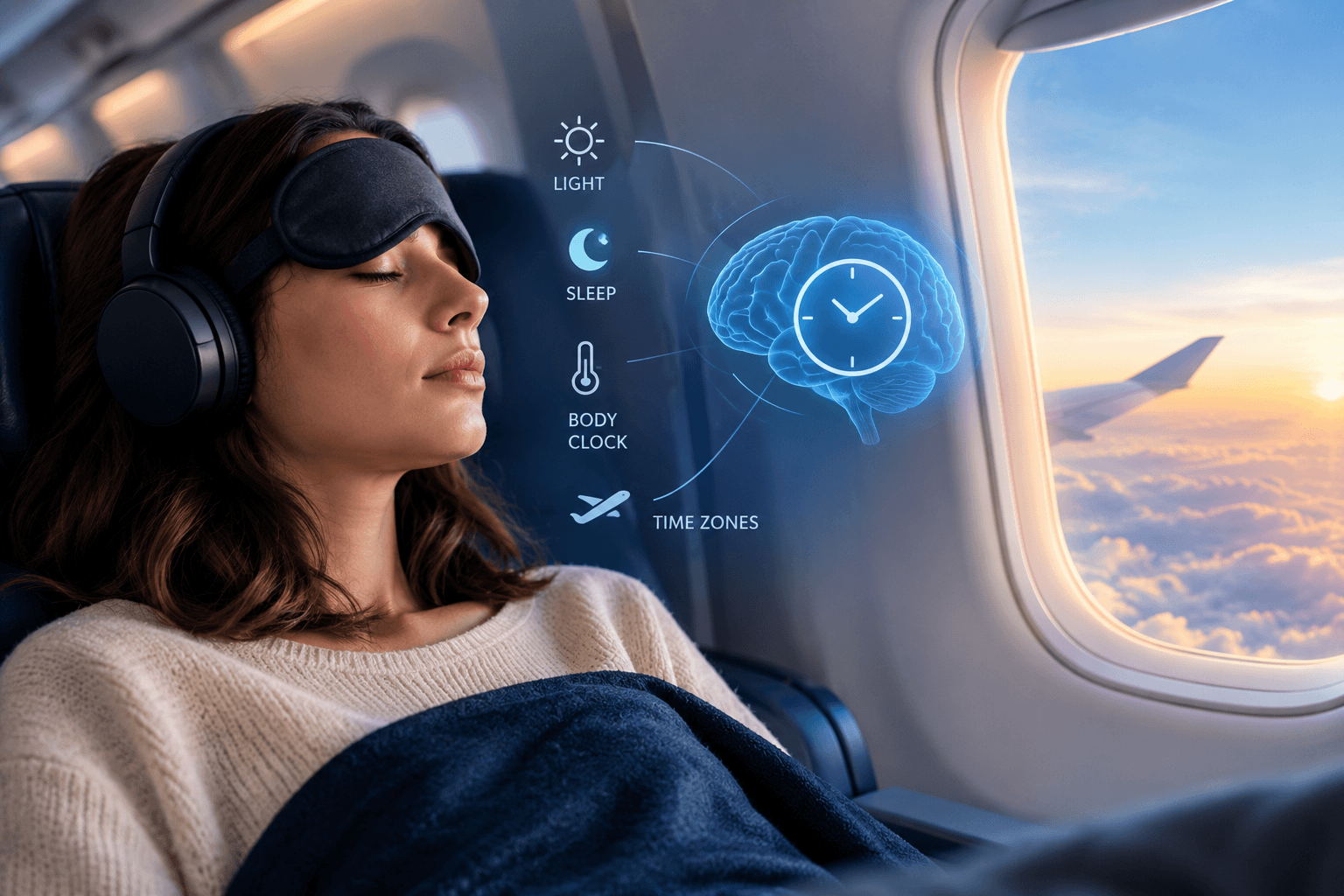
The suprachiasmatic nucleus (SCN) — a tiny paired structure in the hypothalamus containing roughly 20,000 neurons — is your body's master pacemaker. It runs on a roughly 24-hour cycle and synchronizes every cell in your body to a coordinated internal time. When you cross multiple time zones rapidly, the SCN's previous light-dark calibration conflicts with the new local time. The result is a cascade of misaligned biological signals: cortisol peaks at the wrong time, melatonin secretion is off by hours, core body temperature cycles incorrectly, and digestive enzymes activate on the old schedule.
Nobel Prize Science
The 2017 Nobel Prize in Physiology or Medicine was awarded to Jeffrey Hall, Michael Rosbash, and Michael Young for their work on the molecular mechanisms controlling circadian rhythms. Their research on period genes in fruit flies revealed how organisms — including humans — maintain internal 24-hour clocks through protein feedback loops. This foundational work underlies all modern jet lag research and treatment strategies.
The SCN is primarily reset by light — specifically, by the timing of light exposure to the retina. The problem with rapid timezone crossing is that your light exposure schedule is suddenly mismatched to your internal clock state. Morning sunlight in Tokyo at the wrong phase of your circadian cycle can actually push your clock further in the wrong direction before it starts pulling it toward alignment.
Eastward vs. Westward: Why Direction Matters
One of the most consistently reproduced findings in chronobiology research is that flying eastward produces worse jet lag than flying westward, for the same number of time zones crossed. The reason lies in the natural drift of the human circadian clock.
Left to run without external light cues, the human circadian period averages slightly longer than 24 hours — approximately 24.2 hours for most people. This means our clocks naturally drift later over time. Flying westward (which extends your day, requiring your clock to run slightly later) works with this natural tendency. Flying eastward (which shortens your day, requiring your clock to advance forward) works against it.
Eastward · Harder
Requires advancing your clock forward — against its natural slow drift. New York → London, Los Angeles → Tokyo. Mornings are brutal; evening alertness comes early and crashes before local bedtime.
Westward · Easier
Requires delaying your clock — with its natural tendency. London → New York, Sydney → Dubai. You get sleepy too early for a few days, but recovery is typically 1–2 days faster for the same zone count.
Research published in the journal Chaos (American Institute of Physics) modeled jet lag recovery mathematically and found that crossing five time zones eastward requires approximately 50% more recovery time than crossing the same five zones westward. For business travelers doing London–New York (5 zones west — relatively manageable) vs. New York–Tokyo (14 zones east in effect, or 10 zones east directly — severe), this asymmetry has significant consequences for meeting performance.
The most common mistake people make is treating jet lag like fatigue. Sleep alone doesn't fix it — only light, at the right time and in the right direction, resets the clock.
Dr. Czeisler Research Group, Harvard Division of Sleep Medicine
What the Science Says Actually Works
The research base for jet lag interventions is more rigorous than most people realize. Stanford's Human Performance Lab, Harvard's Division of Sleep Medicine, and chronobiologists at the University of Munich have produced a fairly clear hierarchy of what actually moves the circadian clock — and what merely makes you feel temporarily better without addressing the underlying misalignment.
Light is the primary synchronizer. The timing of bright light exposure relative to your current circadian phase determines whether light advances your clock (pushing it earlier) or delays it (pushing it later). Getting this wrong — for example, seeking light at the wrong circadian phase for your direction of travel — can worsen jet lag. Dr. Andrew Huberman's research at Stanford's neuroscience program has emphasized morning sunlight's role in phase-advancing the clock for eastward travelers.
Melatonin is a signal, not a sedative. Melatonin doesn't work by making you sleepy — it signals your SCN that it's nighttime. Low doses (0.5mg) taken at the destination's local evening time are significantly more effective at accelerating clock resynchronization than the large doses (5–10mg) sold in pharmacies. Research from Harvard's sleep laboratory suggests that correctly timed 0.5mg doses can reduce jet lag recovery time by approximately one day per dose timing.
Meal timing affects peripheral clocks. Research from the Salk Institute and Satchidananda Panda's laboratory has demonstrated that peripheral circadian clocks in the liver, gut, and other organs are reset partly by meal timing independently of the SCN. Eating at the destination's local meal times — starting on the flight — can accelerate overall resynchronization even while the master clock in the brain catches up more slowly.
Salk Institute Research
Dr. Satchidananda Panda's work on time-restricted eating at the Salk Institute found that peripheral organ clocks — including the liver — reset primarily in response to meal timing, somewhat independently of the light-driven master clock. For travelers, this means eating at destination local time starts resetting part of the system immediately, even before light cues can realign the SCN.
How Airlines Are Fighting Jet Lag at the Cabin Level
The features engineered specifically around circadian science — not just comfort.
Qantas · 787 Dreamliner
Project Sunrise Cabin Protocol
Qantas's research with the University of Sydney's Charles Perkins Centre developed a specific protocol for ultra-long-haul flights: meals timed to destination timezone, cabin lighting shifted to match destination day/night, and humidity maintained 20% higher than standard. Project Sunrise research flights from Sydney to London (19 hours) showed measurable improvements in passenger circadian markers on arrival.
Circadian TimingEmirates · A380 & 777
Dynamic LED Cabin Lighting
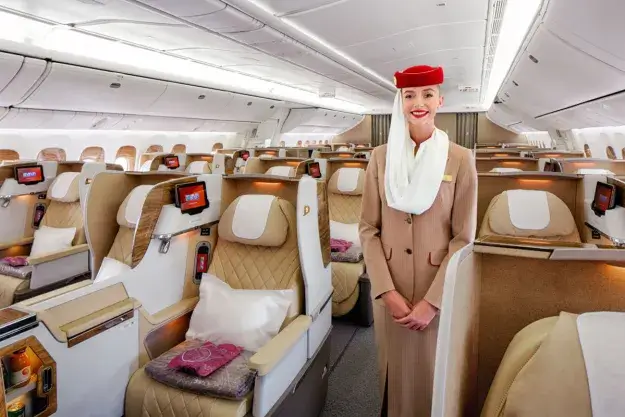
Emirates' Signature Suite and Business Class cabins use LED lighting that shifts through a spectrum from cool blue-white (suppresses melatonin, promotes alertness) during daytime service to warm amber (promotes melatonin production) before sleep windows. The shift timing can be calibrated to the destination timezone, using the same photobiology principles that underpin clinical light therapy for circadian disorders.
Light TherapySingapore Airlines · A380 Upper Deck
Destination-Timed Menus
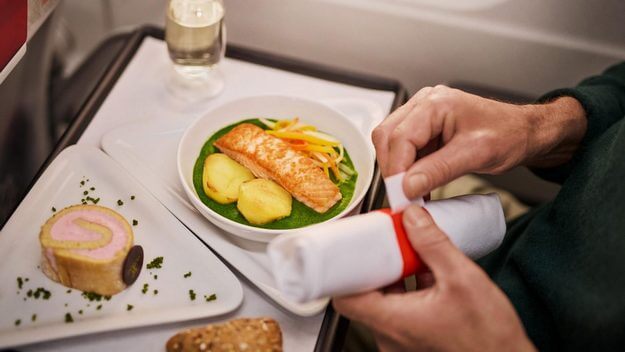
Singapore Airlines has formalized the timing of meals to destination local time on its longest routes, with menu items for pre-sleep windows specifically designed around tryptophan-rich ingredients (a melatonin precursor) — including warm milk options, turkey-based dishes, and foods high in complex carbohydrates that support serotonin production. The approach is documented in their catering brief for ultra-long-haul routes.
Nutrition ScienceBritish Airways · Club Suite
Timeshifter Partnership
British Airways was among the first airlines to formally partner with Timeshifter — the app developed by leading jet lag researchers including Dr. Steven Lockley from Harvard Medical School. The partnership gives BA business class customers free access to personalized jet lag plans built from their flight itinerary and chronotype. Timeshifter's plans specify light exposure, melatonin timing, and activity timing to the hour.
App + ScienceAir New Zealand · Business Premier
Skybeds + Controlled Sleep Windows
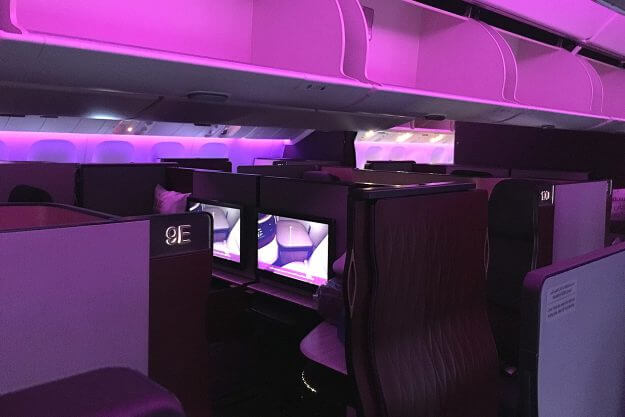
On its Auckland–London and Auckland–New York routes, Air New Zealand structures its Business Premier service around a single controlled sleep window rather than the common "eat whenever you like" approach. Cabin lights are dimmed uniformly, meal service is consolidated before and after rather than distributed through the sleep window, and crew minimize ambient noise during the timed rest period.
Sleep ArchitectureLufthansa · First & Business
Hydration-Focused Service Design
Lufthansa's long-haul service guidelines include proactive water service every 90 minutes independent of meal service, specifically addressing the dehydration that compounds fatigue. While not directly a circadian intervention, addressing the 8% cabin humidity effect (which independently impairs cognitive function and speeds physical fatigue) makes the other circadian-supporting choices — light exposure, melatonin timing — more effective by improving baseline physical state.
HydrationTimeshifter: The App Built by Sleep Scientists
Of all the jet lag tools available in 2026, Timeshifter has the most rigorous scientific pedigree and the most specific claims. Founded in part by Dr. Steven Lockley — a circadian researcher at Harvard Medical School who has published over 200 peer-reviewed papers on sleep and circadian rhythm — the app builds personalized jet lag plans from your specific flight itinerary, chronotype (whether you're naturally a morning person or night person), and preferences about caffeine use.
The plans specify, in hourly increments, when to seek light and when to avoid it, when to take melatonin (and at what dose), when to drink caffeine, and when to nap (and for how long). The core insight from Lockley's research is that the same intervention — say, a melatonin dose — can advance your clock, delay it, or do nothing, depending entirely on where you are in your circadian cycle when you take it. General advice like "take melatonin before bed at your destination" is therefore either helpful, neutral, or counterproductive depending on the person and the specific flight.
Timeshifter Science
Clinical trials testing the Timeshifter protocol found that participants who followed the full plan — light, melatonin, and caffeine timing — reported significantly lower jet lag severity scores compared to those flying the same routes without a protocol. The effect was largest for eastward travel, where the circadian challenge is greatest and general advice most likely to be wrong for a given chronotype.
The app is free to use for one trip per year, with a subscription for frequent travelers. British Airways, and more recently several other carriers, now offer free access to business class passengers on long-haul routes. It has become, for many seasoned business travelers, as standard a part of long-haul preparation as booking the aisle seat or packing the sleep mask.
What Business Class Actually Fixes — and What It Doesn't
The flat bed is the most frequently cited advantage of long-haul business class. And it does provide genuine physiological benefit — horizontal sleep allows a fuller sleep architecture (including deep NREM and REM stages) compared to upright dozing, which is primarily light NREM sleep. A 2022 study from the Woolcock Institute of Medical Research in Sydney found that business class flat bed passengers arrived with significantly lower cortisol levels and better performance on cognitive tests than economy passengers on the same flights.
But the flat bed fixes sleep deprivation, not circadian misalignment. Even if you sleep perfectly in your business class suite — eight full hours, horizontal, with eye mask and ear plugs — you will still have jet lag if your body's master clock hasn't shifted to the destination timezone. You'll arrive rested but still jet-lagged: your cortisol will peak at the wrong time, your alertness will crash at 3 p.m. local time, and you'll wake at 3 a.m. wide-eyed and confused.
What the better business class cabins are now attempting to do — through lighting design, meal timing, Timeshifter partnerships, and humidity management — is layer circadian synchronization support on top of the sleep quality that a flat bed already provides. These two things together produce meaningfully better arrival performance than either alone.
A Practical Protocol for the Long-Haul Traveler
- Download Timeshifter before every intercontinental trip. Enter your flight details and chronotype. Follow the light, melatonin, and caffeine timing it generates — not general advice, because general advice may be wrong for your specific clock phase.
- Start shifting to destination time before you fly. For trips of more than 6 time zones, shifting sleep and wake times by one hour per day starting 2–3 days before departure measurably reduces recovery time. Timeshifter includes a pre-flight phase for this.
- Manage light exposure on the plane deliberately. Use the window shade and the eye mask not just for comfort but as circadian tools. If your Timeshifter plan says avoid light during a certain window, the eye mask is doing real physiological work.
- Eat at destination local meal times starting on the flight. Even in the air, eating at the destination's local breakfast, lunch, and dinner times starts resetting peripheral clocks. Decline the meal at 11 p.m. destination time even if the crew is serving it.
- On arrival, get outdoor light at the right time. For eastward travel, morning light is critical. For westward travel, afternoon light helps. Check Timeshifter for the specific window — it gives you the exact local time range when light exposure will advance or delay your clock in the desired direction.
- Avoid alcohol as a sleep aid. Alcohol produces drowsiness but severely disrupts sleep architecture — eliminating or reducing REM sleep — and dehydrates you in an environment already hostile to hydration. The net effect on circadian recovery is negative even if you fall asleep faster.
Frequently Asked Questions
How long does jet lag last?
The general rule is approximately one day of recovery per time zone crossed, though direction matters significantly. Eastward travel typically takes 20–50% longer to recover from than the same number of zones westward. With no intervention, crossing 10 time zones eastward can produce 10–14 days of partial disruption, though acute symptoms typically resolve in 4–7 days.
Does melatonin cure jet lag?
Melatonin is a circadian signal, not a sleeping pill. Correctly timed low doses (0.5mg) can accelerate clock resynchronization. Incorrectly timed doses do little or can shift the clock in the wrong direction. Research from Harvard's sleep laboratory suggests properly timed melatonin can reduce jet lag recovery time by approximately one day, but only when timed to circadian phase — not just to local bedtime.
Is business class worth it for reducing jet lag?
The flat bed addresses sleep deprivation but not circadian misalignment — the two distinct components of jet lag. Business class passengers arrive better rested with lower cortisol levels (documented in research from the Woolcock Institute), but still require circadian resynchronization strategies. The best business class cabins layer both: sleep quality from the bed, and circadian support through lighting, meal timing, and hydration management.
What is the Timeshifter app and does it work?
Timeshifter is a jet lag management app developed in part by Dr. Steven Lockley of Harvard Medical School. It generates personalized plans based on your flight itinerary and chronotype, specifying optimal timing for light exposure, melatonin, and caffeine to the hour. Clinical testing has shown meaningful reductions in jet lag severity scores compared to unmanaged control groups, particularly for eastward travel.
The FlyLuxury Recommendation
Choose airlines that have actively built circadian recovery into their long-haul service design. Qantas, Singapore Airlines, British Airways, and Emirates are currently leading the field. Combined with a Timeshifter plan and deliberate light management, the right business class cabin can meaningfully reduce the recovery time that costs productive days at your destination.
Sources
- Nobel Prize Committee — 2017 Nobel Prize in Physiology or Medicine (Hall, Rosbash, Young — circadian rhythm molecular mechanisms)
- Harvard Division of Sleep Medicine — Circadian Rhythm Research and Jet Lag Intervention Studies
- Chaos: An Interdisciplinary Journal of Nonlinear Science — "Dynamical model of jet lag" (AIP Publishing, 2016)
- Timeshifter — Scientific Basis and Clinical Research Overview
- Dr. Andrew Huberman, Stanford Neuroscience — Light Exposure and Circadian Clock Synchronization Research
Subscribe to our newsletter
Subscribe to our newsletters and be the first to receive updates on our latest sales and exclusive offers unavailable online